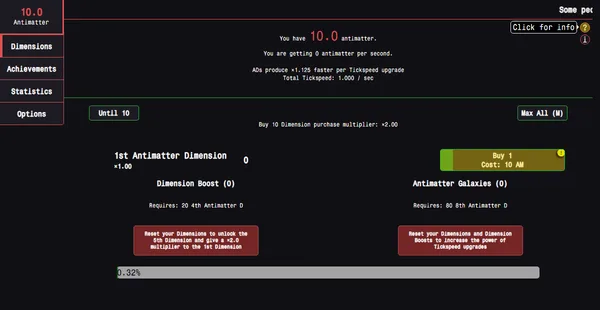
If you only ever play one incremental game, play this one. Antimatter Dimensions is the game most other incrementals are measured against, and the reason is that it keeps pulling the floor out from under you. You spend your first half hour learning that buying the eighth dimension makes the seventh produce faster, which makes the sixth produce faster, and so on down to the antimatter counter. Then the game takes that entire structure away and hands you a new one built on top of it. It does this seven or eight more times over the following two hundred hours.
The core loop
There are eight Antimatter Dimensions. The first produces antimatter. Each of the others produces the one below it. So the whole economy is a chain of nested exponentials, and every purchase you make is really a purchase of acceleration rather than income. Alongside them sits Tickspeed, which shortens the game's internal tick and therefore multiplies everything at once. The tension of the early game is entirely between those two: more dimensions, or faster ticks.
That is a very simple engine, and it holds up because the numbers move fast enough that you are always about three seconds away from a decision. There is no "wait ninety minutes for the next building" pacing here.
Resets, and there are a lot of them
The reset structure is what people actually mean when they call this game deep. It nests, and each layer keeps the layer below it running.
Dimension Boosts and Antimatter Galaxies are the small ones. A Boost wipes your dimensions to give you a permanent multiplier and eventually opens the seventh and eighth dimensions. A Galaxy wipes rather more and makes Tickspeed cheaper. You will do hundreds of these, and by mid game you will have autobuyers doing them for you at thresholds you set.
Infinity arrives when antimatter reaches 1.80e308, the largest number a double-precision float can hold. That is not an arbitrary target, it is the actual ceiling of the number type, and hitting it triggers a Big Crunch that resets everything for one Infinity Point. Later, a chain of upgrades called Break Infinity lets you keep going past that ceiling and earn far more than one point per crunch. Crossing that line for the first time is one of the better moments in the genre.
Eternity arrives when Infinity Points reach 1.80e308. Same ceiling, one layer up. Eternity opens Time Dimensions, a Time Study tree you spend Time Theorems on, and Eternity Challenges that rewrite the rules of the run. Time Dilation later trades raw speed for a currency you need to progress at all.
Reality is the big one. It resets everything again and gives you Reality Machines and Glyphs, randomly generated equipment with rolled stats that you sacrifice and re-roll for better ones. It also gives you the Automator, an actual scripting language for writing your own reset loops. Past that come the Celestials, seven of them, each a themed challenge with its own mechanics, ending with Pelle, who permanently dooms your Reality and turns the whole game into a difficult final gauntlet you cannot back out of.
Controls and mobile
Mouse and keyboard, and mostly just clicking buttons in a tabbed interface. There are useful keyboard shortcuts, and learning four of them changes the game: 1 to 8 buy ten of a dimension and shift plus the number buys one, T buys max tickspeed, M buys the max of everything, and C crunches. Holding alt while pressing any of those toggles that thing's autobuyer instead, which is the shortcut nobody finds on their own. Once autobuyers are unlocked the game plays a lot of itself while you decide when to pull the trigger on a reset.
In a phone browser it is playable but cramped. The interface assumes a wide window with a lot of information visible at once, which is the correct choice for the game and a poor one for a 390-pixel viewport. There are native Android and iOS ports by Jakub Kajfosz with layouts built for a phone, and saves are compatible with the web version, so the sensible pattern is to play on desktop and carry the save to your phone rather than starting there.
Offline progress works, and it matters. The game calculates what you missed while the tab was closed, so leaving it overnight is a legitimate strategy rather than a waste.
How long it takes
Long. Player-tracked Steam completion data puts the median full completion around 250 hours of elapsed play, with plenty of people well past 500. A lot of that is idle time rather than active attention, but this is a game measured in weeks and months, not evenings. Reaching your first Infinity takes a couple of hours. Reaching Eternity takes a day or two more. Everything after that expands.
Tips
Buy the Dimension Boost and the Galaxy as soon as they are affordable in the early game. New players hoard antimatter for a bigger reset, and it is almost always wrong; resets here are cheap and compounding.
Read the Achievements tab. Many give real production multipliers rather than badges, and a few are easy detours worth taking deliberately.
Turn on autobuyers and then tune them. The defaults are conservative. Setting Infinity to trigger on a time or an Infinity Point threshold rather than clicking manually is the single biggest jump in throughput in the first hundred hours.
When you reach the Time Study tree, look up a study path rather than clicking around. Theorems are scarce enough that a wrong split costs real time, and the community solved this years ago.
Who made it and where to play
Antimatter Dimensions was created in 2016 by Hevipelle (Ivar Kerajärvi), a Finnish developer, and has since been worked on by a team including Omsi, Razenpok, Spectralflame and WaitingIdly. The browser version is free at ivark.github.io/AntimatterDimensions. There is a free Steam release published by Hevipelle and Makopaz, and phone ports on Google Play and the App Store.
The game's source is on GitHub at IvarK/AntimatterDimensionsSourceCode under the MIT licence, copyright (c) 2017 IvarK. Note for anyone poking around: the separate IvarK/AntimatterDimensions repository is the prebuilt deploy and carries no licence file at all. The grant lives only in the source repository.