Nearly every game here keeps running while its tab is open and you are looking at something else. That is the genre and it is not what this page is about. Offline progress is the narrower and much rarer promise: the numbers keep moving while the tab is closed, the browser is quit, and the laptop is in a bag.
The distinction decides what kind of thing a game can be in your life. Without offline progress you need a tab you never close, which is fine on a desktop that stays on and impossible on a work machine that reboots nightly or a phone that kills background pages. With it, a game can survive being checked twice a day for a year, which is the only way most of the long ones ever get finished.
How each of these handles the hours you were gone
The implementations divide into three: the ones that simulate the missing time outright, the ones that hand it back on a cap or a schedule of their own, and the ones that pay for part of it and not the rest.
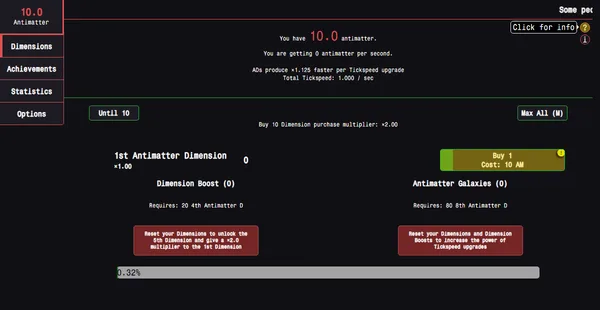
Antimatter Dimensions simulates them. On load it works out the ticks you missed and hands you the result, so closing the laptop overnight is a legitimate move rather than eight hours thrown away. The game runs to something like two hundred and fifty hours, so this is not a convenience feature, it is the reason anyone with a job finishes it.
Swarm Simulator does the same thing and then shows its working. Come back and it tells you how long you were away and exactly what your swarm produced in that time, itemised, rather than adjusting a total behind your back. That report is the difference between trusting the feature and hoping it worked, and it makes Swarm one of the better games in the catalogue to check on twice a day rather than watch.
Melvor Idle is the one built around it. Only one skill runs at a time, so the offline calculation has exactly one thing to resolve, and closing the tab or the app banks the progress instead of losing it. It is also the rare game here whose phone version is not a compromise, which means the offline model and the way you actually play it agree with each other. The catch is the reverse of the usual one: progress survives being away, but the game still wants an internet connection to run, so a plane is a worse problem for Melvor than a week is.
Kittens Game does something stranger, and it is the best version of this idea in the catalogue. While the tab is closed or paused you accumulate temporal flux at a fixed rate. Flux is a resource: you spend it to fast-forward the game when you return, and there is a separate capped offline catch-up on top of that. Absence is not compensated, it is banked, and you choose when to cash it. A day away becomes something you deliberately spend at five o'clock instead of something the game quietly hands you at the door.
Trimps calculates offline progress on your return and gives you a setting controlling how it is applied, which is more consideration than most of the genre gives it. It also needs it most, because a Trimps run is measured in weeks and you will be away in the middle of one.
Synergism itemises what accumulated while you were gone, like Swarm, but caps how much offline time you can bank at once. A cap is a normal balance decision and several games here use one. The thing to know about this one is that the cap is an item on the shop list: PseudoCoins, the premium currency sold through the official version, buy an upgrade that extends it. The game is entirely playable without any of that, and it is the only place in this collection where the size of your offline payout is something money touches.
NGU Idle pays for the grind and not the loot. Titans and the background floors of the ITOPOD keep working while you are away, so your numbers do climb, but the game states plainly that no items drop while you are offline. Since equipment is what actually gates your progress through the zones, an overnight absence advances the parts you were not waiting on. That is a coherent position rather than a bug, and it is the reason NGU rewards being present in a way the games above do not.
Cookie Clicker is the awkward one, and it is on this page by hand rather than by tag. Offline production is not in the game you start. It arrives later as a heavenly upgrade, bought with the prestige currency you only hold after your first ascension, and it pays a fraction of your normal rate rather than all of it. The honest answer to whether Cookie Clicker has offline progress is: eventually, partly, once you have paid for it. A tag cannot carry that sentence, which is why the membership of this page is written down rather than derived.
The ones that stop dead, and why one of them is right to
Progress Knight has no offline progress whatsoever. Time passes only while the tab is open and unpaused, which is the loudest complaint from anyone arriving off Cookie Clicker. It fails conveniently, though: it autosaves every three seconds and all it wants is a background tab, which is a situation plenty of people are already in.
A Dark Room does not want the feature. It runs about three hours, it has no prestige loop, and it ends rather than looping, so there is nothing for an absent player to be paid for. A game that finishes does not need to keep paying you overnight.
Evolve Idle is the near miss worth knowing about, because its own FAQ answers the question with a flat no. What it has instead is Accelerated Time: pause or close the window and you bank one minute of accelerated time for every minute and a half stopped, up to a cap, and the game then runs at double speed until the bank is spent. That is compensation for a break rather than production during one, and the difference matters when the game runs to months. Treat Evolve as a tab you leave open.
What separates a good implementation from a bad one
The first question is whether the offline rate matches the online rate, and whether the game says so plainly. A capped or reduced catch-up is a defensible balance decision and every game above uses one somewhere. A game that advertises offline earnings and then quietly pays a tenth is not balancing, it is misleading. The best behaviour in the catalogue is Swarm Simulator's and Synergism's: an itemised list of what arrived, so the claim is checkable instead of felt.
The second is whether the catch-up costs you anything. This is the mechanic mobile clones most often corrupt: the hours accrue, and then collecting them wants an ad view, or a doubling button, or a currency. Nothing here does that, and every game on this page hands back the time it owes you for free. Synergism is the one to be clear-eyed about, since the ceiling on how much time it will bank is a thing the shop can raise. That is a smaller sin than charging for collection, and it is still the direction the bad version of this feature always comes from.