An unusual share of the best games in this genre are open source. That is not charity. An incremental is a save file, a tick loop and a large spreadsheet of balance numbers, so one person can finish one alone, and a person who finished one alone tends to put it on GitHub rather than build a storefront around it.
For a player the licence is usually invisible. It matters when the original site goes down and somebody needs to host a copy, when you want to read the balance numbers instead of guessing, when you want to fork something, and when a site like this one wants to serve the game itself rather than sending you elsewhere. That last case is why the licences are named here rather than left in a footnote.
What is here, and under what
Loosest terms first, strictest last.
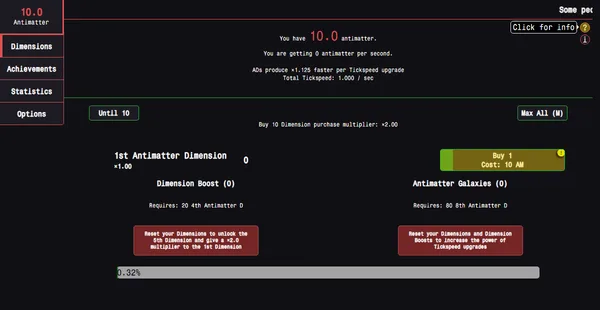
Antimatter Dimensions is MIT, which is as permissive as it gets: use it, change it, ship it, keep the copyright notice. That is why it is one of the two games on this site you can play without leaving the page. We build it from the source repository at a pinned commit, with every third party request stripped out, and the licence page names the commit so the claim is checkable rather than decorative.
Synergism is MIT as well, copyright 2019 to 2025 Platonic and Khafra, and it is a useful demonstration that a permissive licence is not the same as a game you can simply lift. Nothing in those terms would stop us hosting a build. What stops us is that a self-hosted copy loses the developer's servers, so accounts, leaderboards, the Steam integration and the game's paid currency would all be inert, and nobody here has yet built one and checked what is left. The licence answers whether you may. It says nothing about whether the result works.
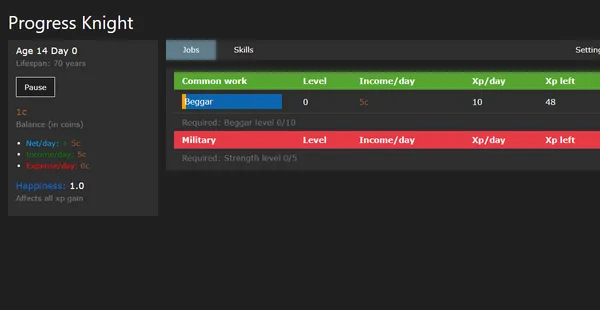
Progress Knight is under the Unlicense, a public domain dedication rather than a licence in the usual sense. There are no conditions to satisfy. We still credit Ihtasham42 and still reproduce the notice, because attribution is a thing you owe someone whether or not a document compels it.
A Dark Room is MPL 2.0, a file-level weak copyleft: modify one of its files and that file has to stay open, but you can combine it with other code without the whole thing becoming MPL. The licence would let us host a copy and we have not built one yet, so this page still links you to Michael Townsend's own version.
Evolve Idle is MPL 2.0 too, which puts one of the largest games in the catalogue under terms that genuinely permit redistribution. The obstacle here is mechanical rather than legal: Evolve is compiled from source rather than shipped as plain files, so hosting it means producing a build and standing behind it, and we do not put a build in front of readers before we have made and checked one. For now the developer's own GitHub Pages copy is the version to play.
Candy Box 2 is GPLv3 with a section 7 additional permission written for this exact situation, which is a more thoughtful piece of licensing than most games in the genre manage. The developer also publishes a plain notice about the source on the game's own site rather than leaving it to the repository.
Swarm Simulator is plain GPLv3, no added permission, and the repository dates from August 2014, which makes it one of the older things listed here. The terms would let us serve a copy. The build would not: the project is CoffeeScript and AngularJS 1.x on tooling that has been dead for years, and reviving that is a different job from reading a licence. It is the clearest case on this page of a game being legally free and practically stuck.
Trimps is GPLv2, the strongest copyleft here. Anything derived from it has to ship under the same terms with source available. That is a real obligation rather than a formality, and it is the reason a game like Trimps has few clones despite being one of the most copied designs in the genre.
What is not here, and why that is fine
Kittens Game has readable source and is not open source. Its custom Wet Paws Licence forbids commercial use and derivative works, so nobody may fork it, host it or frame it, including us. Cookie Clicker has no redistribution licence at all and its own source notice asks people not to re-host it. Both are excellent and both are correctly absent from this list. Source you can read is not the same permission as source you can use, and a lot of the sites mirroring these games have not bothered with the distinction.
The other absences are simpler. Clicker Heroes, Melvor Idle and NGU Idle are closed commercial products with no public source at all, so there is nothing to read and nothing to argue about. Notably, none of the three is worse for it, and Melvor's store page is blunter about not selling microtransactions than several open projects here are about what they do sell.
What separates a good open source incremental
The first thing is whether the repository is where the game actually lives. Antimatter Dimensions is developed in the open with a team credited on it, and Evolve's author was still pushing commits the month we wrote this page. Compare that against a repo that is a one-off dump of a minified build, which technically satisfies the licence and gives nobody anything to work with.
The second is what the licence is trying to achieve. GPLv2 on Trimps means forks stay open, which suits a game with a long tail of community variants. MIT on Antimatter Dimensions means anyone could learn from its prestige layering, and plenty did. Neither is better in the abstract, and a project that picked one on purpose usually shows it in how the repository is kept.
The third only becomes visible once you have a few of these side by side, and three of the games above sit in it: permission to redistribute is common, and a copy you can actually stand up is not. Synergism needs servers it will not have, Evolve needs compiling, Swarm needs a decade dead toolchain revived. Any site claiming to host the open source half of this genre either did that work or served you something broken, and the second is much more common than the first.
If you plan to fork any of these, read the notice file rather than the summary above. We reproduce the full text on the licence page of every game we build ourselves, copyright line included, exactly as written.