A prestige system is a voluntary reset that pays you a permanent bonus. You give up the run, the game gives you a multiplier that survives, and the next run reaches the same place faster and then goes past it. The arithmetic of why that compounds is worked through in our explainer; this page is about which games do it, what each one takes, and how far down the layers go.
This is closer to the defining mechanic of the genre than a feature some games happen to have. Without it an incremental has an ending and a player has a week. With it the same content can hold somebody for a year, because every reset re-prices the ladder you already climbed.
What each one takes and what it returns
Roughly in order of how much a reset destroys, starting with the games that wipe a run and ending with the ones that wipe the thing that wipes the run.
Cookie Clicker has the version everyone learns first. Ascending wipes the run and converts your lifetime cookies into heavenly chips and prestige levels at one to one, each level adding a permanent percentage to production. Chips buy heavenly upgrades that survive every future reset, which is where the decisions are, because those upgrades change what the game does rather than only how fast.
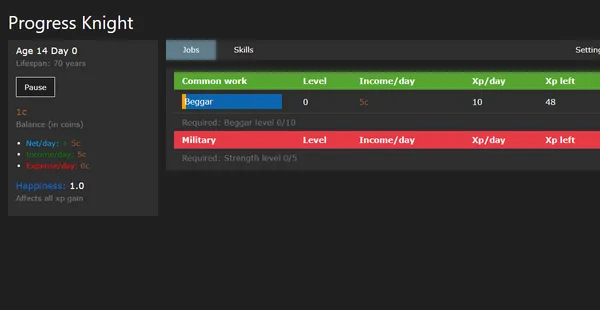
Progress Knight hides the reset inside the fiction, and it is the cleanest use of the mechanic here. You age. At seventy you die, and you rebirth with permanent experience multipliers. There is no lever labelled prestige and no moment where a player wonders whether now is the right time, because the game decides for you. It also means the reset carries an emotional shape a button does not.
Swarm Simulator has one layer as well, and it prices it in a way nothing else on this page does. Ascending moves your insects to a new world, which almost none of them survive, and returns mutagen, a permanent strengthening of every member of the next swarm, along with a count of the worlds you have infested. Crystals carry through too. The cost is paid in energy, the same capped resource you spend on abilities during the run, and that cost falls the more energy you have already spent. Most games quietly reward hoarding. This one charges you for it.
Clicker Heroes is the two layer version, and the first layer is hidden. Ascension is not a button on the interface, it is an upgrade you buy from Amenhotep, the eighth hero, at level 150, so the moment you work out what that hero is for is the moment you understand the game. Ascending takes your gold, hero levels and zone progress and returns Hero Souls, one for every two thousand hero levels you had bought, each worth a permanent ten percent damage. Transcendence, unlocked by beating the boss of zone 300, throws away the Hero Souls and the Ancients you spent them on as well, and pays Ancient Souls plus a global multiplier following a fixed curve that approaches twenty-five percent and never arrives. Its diminishing returns are written into the maths where you can read them rather than implied.
NGU Idle calls it Rebirth, and the reset itself is gentler than anything above. It restarts your progress through the zones and clears your accumulated energy and magic, but your permanent upgrade levels and your best equipment carry through, so a rebirth is a rerun at higher speed rather than a loss. The depth is in what sits around it. Challenges are rebirths with a rule imposed and a permanent reward for finishing. The difficulty modes, Normal then Evil then Sadistic, rebuild the systems you already know with harsher numbers and new mechanics attached, which is a reset of the game rather than of the save.
Kittens Game makes the payout depend on how large the village was when you pulled the lever. Above thirty-five kittens you bank karma, a permanent happiness bonus. Above seventy you earn paragon, one point per kitten past the threshold, spendable in a metaphysics tree on structural upgrades rather than flat percentages. A second reset economy then sits on top: chronospheres carry resources through, cryochambers carry kittens through, and a challenges list adds optional handicaps with permanent rewards.
Trimps stacks four layers and confuses everybody by using the word prestige for the one that is not the prestige. Equipment prestiges are an in-run upgrade that resets a piece of gear to level one and makes every level after that far stronger. The Portal is the real reset, spending Helium on permanent perks you re-buy from scratch each time. Challenges are a portal with a rule attached. Universe 2, far in, is a second parallel game sharing your save. Four layers is not a boast, it is the reason the game has no ending.
Synergism stacks five and names them all. Prestige converts coin production into Diamonds and Crystals. Transcend eats that and pays Mythos shards. Reincarnate eats both and returns Particles, Atoms and Obtainium for the research tree. Ascension wipes the entire lower structure for Wow! Cubes, Tesseracts, Hypercubes and Platonic Cubes. Singularity resets very nearly everything you have ever held, for Golden Quarks. What lifts it above a tall stack is the Corruption dial: at Ascension you choose how badly to sabotage your own run across eight axes with names like Drought, Extinction and Illiteracy, and the payout scales with the damage you accept. That is a reset you configure rather than one you simply take.
Evolve Idle goes sideways rather than down, which is where a ranking by depth stops working. It does not stack layers, it offers a menu of endings, each of which is a reset. Mutual Assured Destruction, available just before the space era, blows up the planet and pays Plasmids scaled to your population and the knowledge you spent. Bioseed wants a seeding ship built and launched, pays Plasmids and Phage, and lets you change which planet you live on next run. Behind those sit Black Hole, Vacuum Collapse, Ascension, Cataclysm, Demonic Infusion, Apotheosis, AI Apocalypse and more, each with its own entry requirements and its own currency, with Plasmids, Phage, Dark Energy, Harmony Crystals, AI Cores, Blood Stones and Soul Gems all separate stockpiles doing separate jobs. The question stops being when to reset and becomes which reset you are aiming at this month, because the route to a Black Hole and the route to Ascension diverge hundreds of hours before the end. Take MAD the first time it appears. A first run is worth very little and new players stall for hours refusing to believe it.
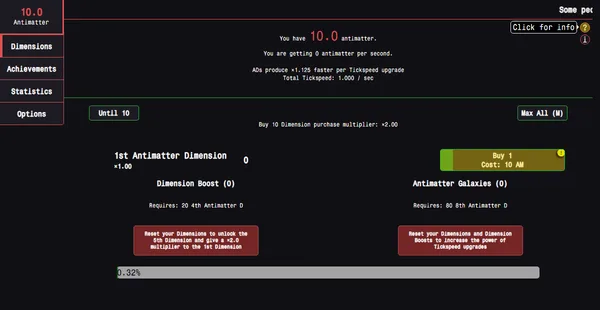
Antimatter Dimensions is the deep end. It resets, then resets the thing that resets, and keeps going for something like two hundred and fifty hours. To see how far this mechanic scales before it stops working, play that one, and it is playable here.
The one in the catalogue that has none
Melvor Idle is worth naming precisely because it is absent from the list above. It has no reset of any kind: no ascension, no run, no multiplier bought with your own progress. The character you make in the first hour is the character you still have three hundred hours later, only better at things. That changes what the game asks of you from optimising a cycle to filling in a spreadsheet over months, which is a fair trade if the cycle was the part you disliked. It is also the clearest evidence in the catalogue that everything on this page is a design choice rather than a requirement of the form.
What separates a good prestige system
The first test is whether the reset changes the game or only the speed. A multiplier that makes run two identical to run one at double pace is arithmetic, not design. Cookie Clicker's heavenly upgrades and Kittens Game's metaphysics tree both spend the reward on new structure, so the second run is a different game and not a faster recording of the first. Synergism goes furthest, since corruptions let you set the shape of the next run yourself and get paid for the difficulty you accepted.
The second test is whether the game tells you when to pull it. Almost every new player resets far too late, grinding a stalled run for hours in exchange for a few percent more currency when a reset would have doubled their reach. Trimps nudges you toward a challenge on your first portal. Kittens Game is blunt about paragon making the second attempt less painful. Clicker Heroes teaches it structurally, by hiding the button inside a hero upgrade you were going to buy anyway. Swarm Simulator has the most elegant answer of the lot, pricing the exit so it gets cheaper the more freely you played, which makes the correct habit and the cheap habit the same one. NGU Idle is the counter-example: nothing tells you, and people sit inside a first rebirth for days because it still looks like progress. A game that leaves the timing entirely to you loses players at the exact point where its best mechanic would have taken over.
One practical note if you go looking for more. The genre never settled on a word for this, and the same word does not mean the same depth twice. Cookie Clicker, Clicker Heroes, Swarm Simulator, Synergism and Evolve Idle all use ascend, and they mean five different sizes of wipe. Progress Knight and NGU Idle say rebirth. Trimps says portal. Synergism alone gets through prestige, transcend, reincarnate, ascend and singularity inside one game. Evolve names its resets after their endings rather than after the act, so nothing in it is called prestige at all. A game's own documentation uses whichever word its developer picked, so searching for the word rather than the behaviour will miss most of them.